


By Andrew Adler
Community Editor
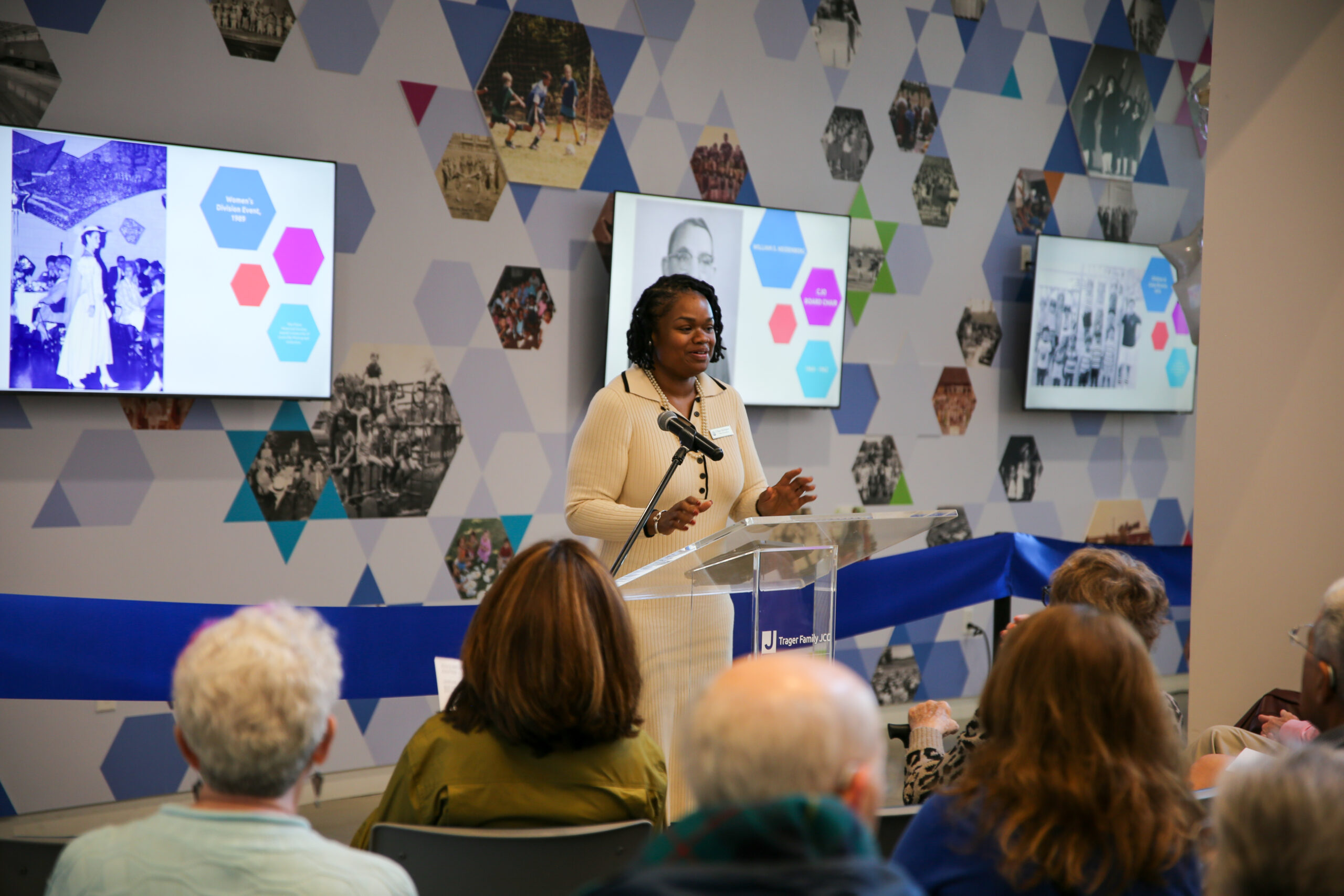
Louisville Deputy Mayor Chan Kemper spoke at the Oct. 22, 2025 dedication of the History Wall at the Trager Family JCC (photo by Mackenzie Lynch)
How do you encapsulate 135 years of Jewish life in Louisville? How do you trace the line extending from the Young Men’s Hebrew Association of 1890 to the Trager Family JCC of 2025? How do you honor the past while looking ahead to the future?
Answer: You take an ordinary expanse of white façade, cover it with artfully designed geometric figures enclosing photographs from three different centuries, and install three flatscreen monitors displaying images plucked out of the city’s most comprehensive and enduring archive.
You have invoked the power of memory. You have created a History Wall.
The History Wall owes its existence to support from the Legacy Foundation of Kentuckiana and the Jewish Heritage Fund, and from the curatorial expertise of the Filson Historical Society, which houses thousands of photographs representing Louisville’s rich Jewish narrative.
Located just behind the Dennis & Judith Hummel Family Gallery space, the Trager Family JCC History Wall invites viewers to pause and consider how Louisville Jews transformed bricks and mortar into gathering places that would resonate for lifetime.
“Welcome everyone and thank you for being here to celebrate the new History Wall, which represents generations of memories, friends and love,” Beth Salamon, board chair of the Jewish Community of Louisville, told guests and staff at the Wall’s Oct. 21 dedication ceremony. “I want to thank all of our donors, sponsors, leaders, members and staff who have supported Jewish life here in Louisville.”
Chan Kemper, who was recently named Deputy Mayor for Law and Compliance in Mayor Craig Greenberg’s administration, spoke about her personal connection to the Trager Family JCC.
“Long before I became Jewish by choice, I spent time coming here for events, seeing friends, and feeling a part of something bigger,” she said. “This center has been a fixture not only in my life, but in the life of our city. For 135 years, the Jewish community of Louisville has created a place to gather and to worship and to care for one another. What began with the Young Men’s Hebrew Association has grown into a vibrant Trager Family JCC and the Jewish Federation of Louisville – a cornerstone of our civic and cultural fabric.
“The new History Wall that is dedicated today captures this story, not only in photographs and names, but in the lives behind them. On behalf of the mayor’s office, and that includes our Jewish community,” Kemper said. “The mayor often says that our city’s strength is our diversity. And nowhere is that more evident than here at the JCC. We’re saying that Jewish life will continue to flourish here, openly and proudly, for the next 135 years and beyond.”
Strong connections also bond the Trager Family JCC – and its former incarnation – to the Legacy Foundation of Kentuckiana. “A number of our advisory council members also have a long personal history with the JCC,” Anne Monell, the foundation’s executive director, remarked during the dedication ceremony.
“The History Wall was one of the very first grants of the (foundation) in 2022,” she said.
A wait born out of striving to fulfill a timeless imperative.
“There’s a Jewish concept and a saying that is very popular: L’dor v’dor – from generation to generation,” said Sara Klein Wagner, president and CEO of the Jewish Federation of Louisville and the Trager Family JCC. “And I think that’s obvious looking at the photos, and at the people who are gathered today in this building.”
Indeed, “one thing we love about the History Wall is that the (video) loops on the screens can continue to grow and change. There are so many stories to tell – so much rich history we hope will prompt you to talk, remember and ask questions, and for the next generation to dream along with us as they build their memories.”
The tangible representation of those memories resides at the Filson Historical Society, where they are a significant component of its vast archive of more than 2 million items.
“The Filson has been a trusted community partner for and repository for thousands of artifacts, manuscripts and family collections from the region’s Jewish community,” said Kelly Hyberger, the Filson’s Director of Curatorial Affairs. “It was only natural to partner with the Trager Family JCC to develop this History Wall installation.”
It was no easy assignment.
“As you might imagine, sifting through thousands of items, photos and diaries can be quite the task,” Hyberger acknowledged. “It’s the most fun part of my job, but it’s a lot of work.” She lauded the efforts of Filson colleagues Ann Niren, its Curator of Jewish Collections; and Brooks Vessels, its Assistant Museum Curator and Exhibits Designer.
“Nearly 400 staff hours ($20,000 worth of in-kind support) were devoted to this project,” Hyberger said, “from pulling the selection of photographs from thousands down to dozens, from considering and contemplating the stories we hoped to share – and finally, through the careful design and presentation.”
With the cutting of a broad, blue ribbon, the History Wall was declared officially open. But the dedication morning wasn’t done yet – attendees made their way to the Fleischaker-Greene Family Community Room, where four panelists shared personal stories about their relationships with successive JCC generations.
Cari Hatch exemplified the ideal of “L’dor V’dor” – from generation to generation.
“My grand(father) was David Kling, my great grandfather was Arthur Kling, and my great-great uncle was Morris Kling,” she said. “All of them have all been past (JCC) presidents here, and my mom sat on the board. So we’ve got a strong family history here.”
Perhaps the most resonant – and certainly the liveliest – presentation was delivered by Jaye Bittner, who recalled working more than 60 years ago as the junior counselor arts and crafts assistant at the old JCC Camp, raking in a tidy $16 for the entire summer. Later “I became a full counselor, and I think I made maybe $25 – I don’t know. They still owe me money,” she quipped.
Eventually Bittner became camp director, where campers typically would bring their lunches. Camp officials “worried about the rabbis telling us, ‘Oh my God, what if they bring ham sandwiches?’ I said, ‘I’m not being paid to look under the bread. I am here to run a camp.’”
Dennis Hummel told of growing up in downtown Louisville and attending the YMHA, located at Second and Jacobs Streets. “My parents would drop me off there, and I was greeted by Mr. Congenial, Maurice Richmond, who was the athletic director.
Once the new JCC opened at 3600 Dutchman’s Lane in 1955, six-year-old Dennis was introduced to its impressive swimming installation. “That was the beginning of many, many days at that pool,” he said, “and the beginning of a wonderful time. So much happened at the (JCC),” Hummel said. “It was the center of the Jewish community. You see in the movies where a lot of kids would go to the malt shop, but we all came to the Center, because as somebody mentioned, we weren’t necessarily welcome everywhere in every circle. We had to do it ourselves.”
The JCC was also where Hummel, as a seventh grader, met a girl named Judy Mazin, who would eventually become Judy Hummel – his wife of 56 years (and counting). “I was starstruck, lovestruck,” he said of that first encounter. “I began my mission to get to know her, and to get to be best friends. And we remain best friends.”
Gerald Temes, a retired (and revered) thoracic surgeon who became one of Louisville’s pivotal Jewish leaders, remembered a time when the city boasted no fewer than “five medical schools and eight hospitals.”
Yet “the community was not well served,” he said, so “a group of Jewish businessmen decided they needed a hospital that would provide service to everyone – free of charge if necessary – and have a place for Jewish doctors to practice without restriction, and for Black doctors to practice without restriction.”
The original Jewish Hospital opened downtown at Floyd and Kentucky Streets, moving to its present location in 1947 when the original facility was decimated by the 1937 flood. Generations later, amid a succession of health-care system sales and mergers, “Jewish Hospital transformed into the Jewish Heritage Fund,” bolstered by a substantial infusion of funds generated by the sale of the hospital properties to the University of Louisville.
Asked by panel moderator Shane Shaps for each panelist “to give us a quick wish for the future of the Jewish community,” Hummel gave an especially encompassing answer:
“I hope we’ll find a way to stay strong, to stay united, and understand that’s the only way forward,” he said. “Because – to borrow ideas from all millennia – if you’re divided, you can be conquered. But if we stay together, be strong, have a vision and know what Judaism is all about, we’ll be fine.”