


By Andrew Adler
Community Editor
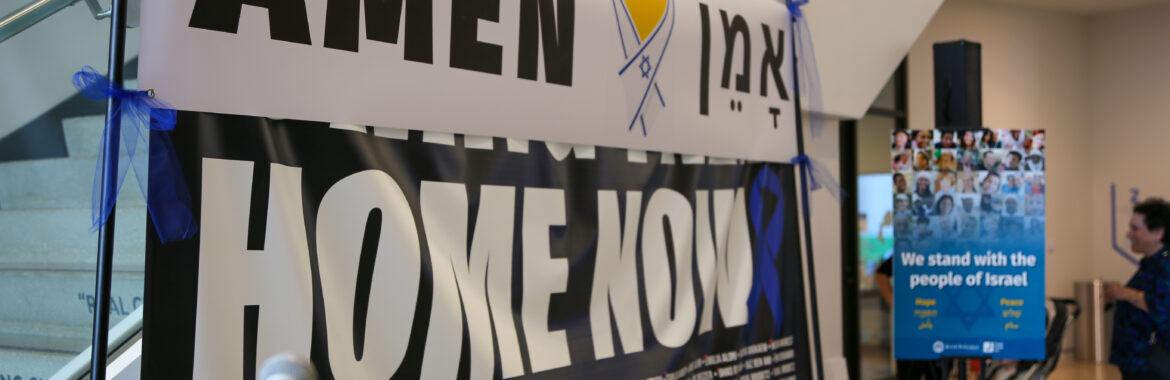
 Two years ago – just days after the horrific events of October 7, 2023 – a large banner was put up on one side of the Weisberg Family Lobby at the Trager Family JCC. Bearing the names of the 251 hostages Hamas abducted into Gaza, the banner remained standing as days turned into weeks, weeks turned into months, and months turned into years. As long as hostages remained trapped in Hamas’s dank, dark tunnels, so would that display of names. It would come down only after all the hostages were liberated and reunited with their families.
On Monday, October 13, 2025, liberation day finally arrived. By then a mere 20 hostages were still alive, with 13 who perished in captivity still somewhere in Gaza. With great relief and rejoicing, tempered by the residual anguish brought on by the murderous events of October 7 and the subsequent two years of deadly conflict, the survivors crossed the border back into Israel.
Here in Louisville, as the annual run of Jewish holidays was nearing its close, there were similar scenes of thanksgiving. And on Monday, October 20 – exactly one week after the living hostages gained their freedom – the banner that had stood silently for so long was at long last taken down.
A few dozen people gathered for an early-afternoon ceremony, participants in a collective expression of elation, relief and gratitude. It began with remarks from Rona and Yael, our young Israeli ShinShinim, who read aloud Aharon Bass’s poem, “New Creation”.
“It says that it’s our duty to recreate ourselves each and every day,” Rona said, “from the depths of chaos, from fragments gathered, from tears that have fallen into a world of renewal, of hopeful anticipation for what lies ahead without forgetting the past – yet always looking toward the future, a future that will and must be better. So, this poem talks about new creation and how – especially as Jewish people – we have to regrow all the time from hard times…because without that and without our spirit, we wouldn’t be so strong.”
“Over the past two years, it’s been tough to feel like we’ve been able to keep out feet solidly on the ground,” said Rabbi Ben Freed of Keneseth Israel Congregation. “And I think that one of the things we’re doing today – and it’s so beautiful that we’re doing it here as a community – is marking this moment, which is both a very Jewish and a very Israeli thing to do.”
Sara Klein Wagner, president and CEO of the Jewish Federation of Louisville and the Trager Family JCC, observed that “we’ve been open for about 41 months in this building, and for more than half of it, the banner with 251 names of hostages has been part of who we are. And as Rabbi said, we are taking a moment to acknowledge that our lobby is changing, the heart of our JCC is changing, and that our hearts have been torn for two years.”
Now those torn hearts may finally begin to heal.
Silence is surrounding
And if you were listening
Maybe, maybe, maybe
You’re coming and walking toward me.
Because my song is a gust in the wind
My open window
My source of strength, laughter, and tears
End of my suffering.
(From a song by Shalom Chanoch, which liberated hostage Alon Ohel wrote on a whiteboard as a helicopter flew him from Gaza to Israel.)
***
With the release of these 20 living hostages still fresh in our minds, we asked several people – here and in Israel – to share their thoughts on the hostages’ liberation and what might lie ahead. Here’s some of what they said:
Ory Rosin, Director of Partnership2Gether Western Galilee Region, who lives in the northern Israeli city of Akko

As I sit down to write about the situation in Israel for your newspaper, I am at my home in the Galilee, having just returned with my family from a festive ceremony in Lavon village, to which the released hostage Alon Ohel is returning these days. I do not presume to analyze the situation or predict what lies ahead, so I will simply share here some thoughts and feelings from these recent days.
The atmosphere in Israel is celebratory these days. The return of the hostages is something we fought for for over two years through various means, trying to convince decision-makers that no price is too high for saving human lives. We are still in the midst of the first phase of the deal that [envoys Steve] Witkoff and [Jared] Kushner led to end the war in Gaza. We hope that the second phase will also come and the war will indeed end. We hope that Gaza too will receive a “Marshall Plan” that will uproot the hatred and jihadist ideology.
Soon the festive atmosphere will be replaced by necessary healing and rehabilitation processes in Israel, primarily in the border communities in the north and the Gaza envelope, but also throughout Israeli society at large.
The Galilee is already quiet and calm, and the sense of security has returned. We hope that the international agreements led by envoy Amos Hochstein will indeed be enforced and Hezbollah will be disarmed under American supervision. Still, my children occasionally ask where the safe room is in places we visit and “what will we do if there’s an alarm?” when we’re spending time in nature. The psychological healing processes will still take a long time.
While many external threats have been removed, it appears that the internal threat – the one within Israeli society – has become sharper. This is perhaps the greatest concern in these post-war days. The current government has already announced its intention to continue legislation for systemic changes while avoiding the appointment of a state commission of inquiry to investigate the events of October 7th. The political-social polarization continues to grow. This we will need to deal with ourselves, and there is no foreign administration that can help.
Michelle Elisburg, Louisville pediatrician and president of the Louisville Chapter of Hadassah
From the first of my three trips to Israel since the war started, I have maintained this dichotomy of joy and sorrow, hope and fear. The Momentum Unity Mission in November of 2023 helped make it clear that there is joy in a broken heart, and it is not only possible but imperative to hold these opposing emotions at the same time. Ultimately, Jewish Joy is how we resist. I will not remove my hostage tag or flag outside my home until the last hostage’s remains are returned. These families deserve to bury their family members with dignity and have closure in accordance with their Jewish, Thai and Tanzanian customs: Leave No One Behind.
I am leery of how this will ever really end; we can see that it didn’t take long for Hamas to break the ceasefire. I don’t trust that the U.S. can simply will peace into being. You can’t just “build it and they will come.” Like many good ideas, the details of implementation are absent.
Will the peace partners pony up to stop Hamas? Is it a good idea to support the anti-Hamas gangs, who are violent in their own way? It feels as though we’re in the Game of Thrones and Winter is Coming – when all the hostile forces formed an alliance to fight their common enemy and then went back to hating each other. I do know there are allies and people like Bassam Eid and Ahmed Fouad Alkhatib who are Palestinians who support Israel while also criticizing many of its government’s policies. If we could identify more people like this to have dialogue, then there is hope for the future. Ultimately, it’s Leonard Cohen and Kabbalah – the cracks are how the light gets in.
Rabbi Ben Freed of Keneseth Israel Congregation
Obviously, things continue to be in flux, but here are my thoughts as of right now: It is a time of fragile hope and optimism, but that’s more than we’ve had for going on two years now. Just as we sat in sukkot last week, we pray that the sukkah of peace that has spread over the region will not be blown away by winds of hatred, intolerance, and violence. I pray and hope that the current ceasefire will transform into the seeds of a peace that will allow all who live in the land of Israel and Gaza to live in safety, security, and dignity. I am not a prophet and cannot tell the future, so I do not try to say with any surety what will happen, I simply echo the words of Israel’s first Prime Minister, David Ben-Gurion: “In Israel, in order to be a realist, you must believe in miracles.”
David Y. Chack, Founding Producing Artistic Director of ShPIeL-Performing Identity Theatre

I am euphoric over the release of the Israeli hostages, and I hope for negotiations, so that something of value will emerge after this horror for both Israelis and Palestinians. I also believe as Jews we must continue to support an Israel with democratic values and policies.
Another concern I see, as a Jewish theater-maker, and Holocaust and Jewish educator, is how stories are a powerful tool for definition. Our story in America has been one of incredible achievements. Jews have been leaders in seeking freedoms, equal rights, diversity, medical and scientific advances, in culture and the arts, and more.
Yet a new story may be introduced, as a result of this ceasefire that may divide us. Rifts among Jews and from outside the Jewish community, will create conflicts and may even lead some to question, not just Jewish values, but the value of being a Jew. My touchstones are the great Rabbi Abraham Joshua Heschel and Nobel Prize Laureate, Elie Wiesel. They believed that to live as a Jew is not to be a better Jew, but to be a better human being.
Ranen Omer-Sherman, Jewish Heritage Fund Endowed Chair in Judaic Studies at the University of Louisville

This was indeed a day of euphoria and the kind of collective celebration that so rarely unifies Israel and indeed the Jewish world these days. Israelis who tirelessly protested for a ceasefire for over two years deserve our gratitude.
Now it is more urgent than ever that we all press for a better future. It is an unprecedented historical opportunity, and we must seize the day. We must not surrender to the Kahanist settlers’ fantasy of removing Palestinians from Gaza, Palestinians must renounce Hamas, and we must instead must vigorously support the two-state solution which remains the only alternative to both Hamas and Netanyahu’s cynical vision of eternal war.
I do think we must also consider the Palestinians released and especially those who weren’t. I’m thinking of Palestinian leader Marwan Barghouti, who Israel [has] refused to release. I mention this because Barghouti, serving a life-sentence on terrorism charges, has long accepted the necessity of coexistence and a two-state solution and is widely regarded by many Israelis and Palestinians alike as the potential Palestinian Nelson Mandela, a voice of reason and a credible leader for a future, more peaceful Middle East.
Rabbi David Ariel-Joel of The Temple, who grew up in Israel

We celebrated Simchat Torah this week, and what a special and joyous Simchat Torah it was! Monday morning, beginning at 1 a.m. in Louisville, which is 8 a.m. in Israel, until the last of the hostages returned, was one of the happiest days of my life. It was one of the happiest and most special days in the history of anyone who feels part of the Jewish people, and indeed for anyone who lives in Israel. After two extremely difficult years, there was suddenly a sense that we could start breathing again. A collective day when the entire Israeli society, the Jewish community, and so many of us were glued to the media throughout the day, looking forward to this joyful event. After living with the pain for so long, we can finally rejoice!
Redeeming captives is a deeply rooted Jewish value. Maimonides declared, “There is no greater commandment than the redemption of captives”. There was a struggle here—weekly demonstrations for two years. And the people succeeded. The people managed to bring them back. To be Jewish is to belong to a people. Our religion, our tradition, is built on belonging. And it was a day of belonging in the strongest sense possible.
The crucial human challenge we face today is restoring trust in humanity, because only on this basis can we build a life in which humans will thrive. Trust in humanity will allow us to create a life of Shalom, for ourselves, our children, and our children’s children.