


Julia Wall
An opinion piece by Julia Wall
Spend any time on social media, explore pop culture, or watch celebrity trends and you’ll see it: Mahjong! Everywhere you look, this complex and engaging tile game is the current belle of the ball, our very own “it girl”. I’m a relative newcomer to the game, having just learned how to play in 2023, but it’s impossible for me to miss… Mahjong is having a moment.
It’s my understanding that Mahjong (which I’ll lovingly call Mahj from here on out) immigrated to the states and gained raging popularity in the 1920s where it appeared everywhere from bougie salons to humble households. This led to Mahj’s first major moment. At that time, Mahj was played in a version closer to its Chinese origin but had NO consistent rules. Chinese Mahjong was traditionally a male-dominated strategy game, similar to Go or Chess, played by scoring based on patterns. I gather that people had their own table or “house rules”, leading to a veritable Wild West of Mahj. Then in 1937 a group of Jewish Mahj enthusiasts came together to standardize rules, create hands, and generate a yearly card, thus forming the National Mah Jongg League. There is endless stipulation about the cultural ties and significance of Jewish women adopting Mahj, the connection between cultural outcast groups in the early 1900s, and thoughtful commentary about how we got here, but I won’t dive deeper into that. I want to talk about the current Mahj Moment.
It seems that all that is old is now new again. Mahj is, once again, all the rage…but with a different demographic. Yes, Mahj players are generally trending female, but here is the divergence: this isn’t your Bubbe’s Mahjong group. I’m not sure how to put this delicately, but it kind of feels like trendy TikTok influencer girls are taking over a game that has been significantly culturally Jewish for decades. I’ve had innumerable conversations with my various Mahj friends about this shift, and I remain at a loss. Am I happy that Mahj is becoming mainstream? Absolutely! I might be able to play more often since there’s an ever-increasing pool of players! Finding a fourth might not be as challenging. Am I incensed that people are monetizing Mahj, charging upwards of $100/hr to “teach Mahj lessons”? Give me a break!! Mahj should be for everyone. AND don’t get me started on spending $700 for a set of tiles OR PLAYING WITH BLANKS!!! Gah…. Did you know there’s also a company that is going so far as to develop and sell their own knock off card? I can’t even. It makes me incandescent with rage!
Is this, dare I say, cultural appropriation? Am I allowed to feel like it might be? Is it OK for me to feel this way when Mahj has only been “a Jewish thing” for about a century? I’m a relative newbie to Mahj and I am absolutely frustrated with the erasure of Jewishness and cultural ties to the game. Jewish women congregated around the Mahj table in suburban homes when the country clubs wouldn’t let us in. We created a Mahj community, women supporting women, when the more upscale “bridge crowd” wouldn’t take us. Now they’re claiming our tiles as their own without even a nod to the essential Jewishness of American Mahjong.
CBS, NPR, and Town and Country are all rushing in to diagnose the how, why, and what of the resurgence of the popularity of Mahj. It feels like everyone and their cousin are starting groups, organizing games, and rushing to pay big bucks to take lessons and buy tiles. Meanwhile my Jewish sisters, and some brothers, are quietly sitting back clucking our tongues. We understand something that the wannabe Mahj Mavens aren’t yet privy to: Mahj is connection, Mahj is community, Mahj is engagement and caring and love and togetherness. Covid ruined our sense of community and connectedness, Mahj is the support of women clawing back. Mahj is our new mental health craze.
So yes, I am certain that the trendy people who are newly taking up Mahj have nothing on the Bubbes meeting every Thursday afternoon at their shul for a game. And no, I don’t think any new fake, non-National Mahjong League cards will take over the game. I don’t believe that playing with blanks to “make it easier” will remain fundamentally Mahj (besides its cheating and no one likes a cheater). Tom Hanks said it best in A League of Their Own, “It’s the hard that makes it good, if it wasn’t hard then everyone would do it.”
Fundamentally, I am equal parts thrilled to have more Mahj friends and frustrated by the sweeping erasure of Jewish heritage as it relates to the game of American Mahjong. In a moment rife with Antisemitism, Antizionism, violence against Jews, vandalism of synagogues, threats against JCCs and day schools, and innumerable other forms of Jew hatred I am deeply disturbed that the pop culture world is quietly appropriating a game that has had a Jewish soul in the US for almost a century.
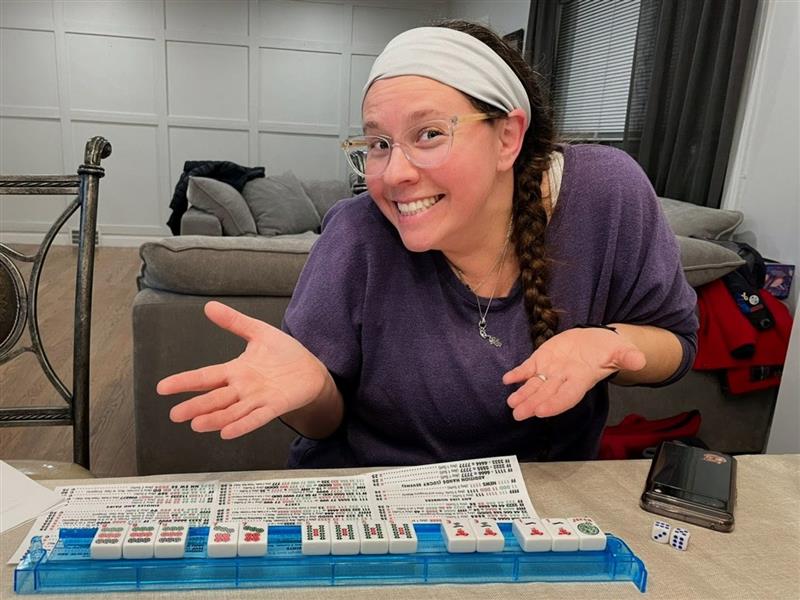
Julia Wall is a relative newbie to Mahj. With just 3 years of play experience under her belt, she is working to create a more accessible Mahjong scene for Jewish women of a certain age, to create community, and a place where we can all kvetch and kvell together. She doesn’t believe that money or status should dictate access to the game she loves so deeply. Julia teaches FREE Mahjong lessons for AgeWell program participants at the Trager Family JCC, plays several times a month, and manages/wrangles/cultivates an ever-growing Mahjong WhatsApp group of friends and acquaintances who are passionate about the game and building the community they want to live in.
Interested in getting involved: Tiles today, tees tomorrow! The Mahjong Tournament Committee invites women who enjoy connection, leadership, and fun with purpose. Held in conjunction with the Republic Bank Player’s Challenge golf tournament, this event supports the Jewish Federation of Louisville and JFCS. Join us in turning a beloved game into meaningful community impact. Contact Lindsey Palgy for more details.
Click HERE to go back to the Women’s Philanthropy April 2026 Newsletter.