



By Lisa Shapiro
Guest Columnist
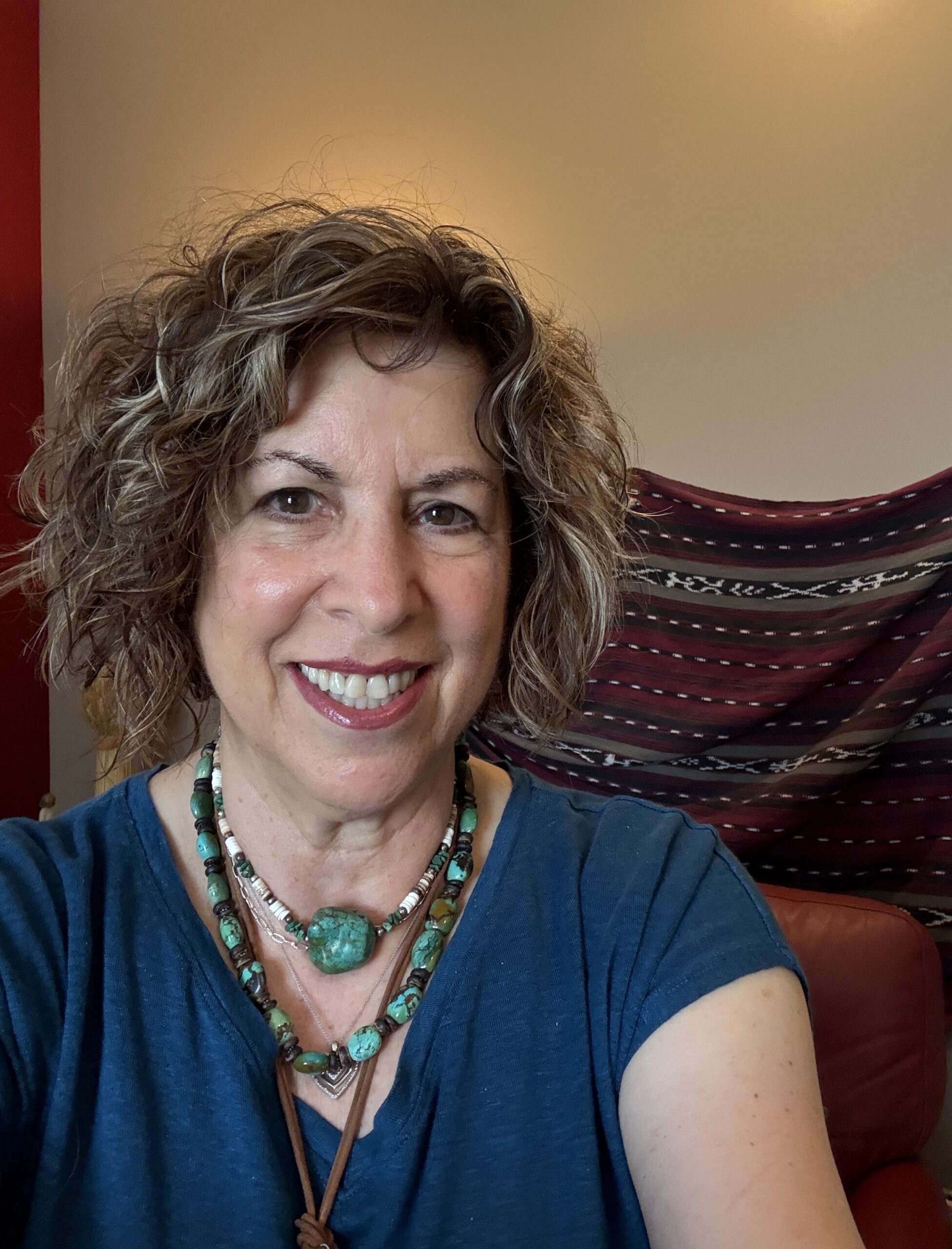
Louisville psychotherapist Lisa Shapiro, LCSW
I was settling in for my interminable flight to L.A. to visit family. I’d arranged my water bottle, snack, and book: Rabbi Harold Kushner’s When Bad Things Happen to Good People, on the tray table in front of me, and gave a neighborly nod to my assigned seat companions.
Next to me on the left was an olive-skinned man perhaps in his late 30s, his wife, and their adorable toddler daughter, being passed back and forth in a dance of wriggles.
I’m not even sure how the conversation started, but it could have been one of those “Where are you from?”
queries that cloak the attempt to pry into one’s ethnicity. Maybe it began with a friendly “Where are you going?” Well, we were going, alright, and it was both a chilling and fascinating journey.
Thank goodness I had taken a one-hour Zoom class sponsored by the Union of Reform Judaism in May of 2024 called “Talk for a Change,” where we were trained to navigate difficult conversations about antisemitism and Israel. The thrust of the training boiled down to one word: “listen.” We were encouraged to not add our own perspective to ugly commentary, but to simply reflect. However, I happen to be a psychotherapist. I’ve been trained to listen, but also to gently steer a conversation in a direction where I think constructive change might occur. So, thank goodness for both influences.
Again, I’m not at all sure I remember how my seatmate began his diatribe. He started in on the “evil Jews of Europe,” and how they “deserved what they got in the Holocaust.” At that moment, due to the shock of what I was hearing, I catapulted into a sort of altered state, and landed somewhere between the psychoanalytic “tell me more” and the sanctioned receptivity of the “Talk for a Change” approach. I could feel the Zoom group nodding in solidarity, and the Psychoanalytic masters encouraging me to seek to understand before saying a word. So, I listened closely to his story about how the Jews of Europe sucked up the resources of whatever village they lived in, destroyed the culture, and once they had drained it dry, moved on to the next village or country and did it all over again. Finally, when he seemed finished, I replied, with concern and compassion, “How terrible for the townspeople. They must have felt so frightened, and enraged as well, at feeling that their culture and property had been ripped from them. Thank you for sharing that.”
I took a pause and gently added “You know, I heard it a little differently. Would you like to know what I heard?” He nodded his consent, so I laid out how tyrannical leaders would spend their subjects into poverty, and when the people became restive and angry, would blame and rise up against the Jews, attack them, murder them, steal their goods and property, and that this was called a “pogrom,” a sort of state-sanctioned genocide. When this occurred, the Jews would have no choice other than to flee and try to make a new life elsewhere, which they did. They miraculously succeeded…until the pattern repeated. Again and again, townspeople were whipped into a frenzy against the Jews and pillaged the Jews’ newly achieved harvests. Terror. Flight. Poverty. Rebuilding Success. Repeat.
My seatmate pondered silently. And then he drew out another piece of undigested material. What about their hatred of the Arabs, and intent to wipe them out, he asked? He had heard of many incidents in Israel where the Arabs were butchered, and his friends were certain that the hope of every Israeli was to wipe out the Arabs entirely.
Again, I commiserated. “That would be terrifying,” I agreed. “Imagine if you are a minority in a country surrounded by citizens who want nothing more than to see you dead?” When I was sure that I had fully reflected his feelings of dread and outrage, I again paused, and said that I had heard of the situation in Israel a little differently, and asked if he wanted me to share with him what I had heard. He said “Sure,” so I spoke.
I first acknowledged that there were “bad actors” in the Middle East, of all ethnicities. I then told him what I had seen there on my travels in 2017…but I protected our fragile connection by attributing the observations to “friends” of mine who had travelled there or lived there. I shared with him peacemaking initiatives, such as the Jewish and Arab women who sample one another’s cooking and write a cookbook together. I told him of the kibbutz on the Gaza border (which was brutally attacked on Oct. 7) where the kibbutzniks gathered at the checkpoint to assist Gazans in obtaining medical care in Israel. I mentioned the unmarked Israeli ambulances that picked up Syrian war victims and brought them back to an Israeli hospital in the Golan for treatment. The Syrian patients were terrified that they were being kidnapped- but then they discovered the Israeli humanitarian approach. I mentioned the many Arab judges, doctors, and politicians.
I also shared a response from my dear late Israeli friend Nira in response to a similar misconception: “Oh, no, we love our Arabs!” Of course, I added that nothing is perfect, and that I was sure there were some very regrettable incidents by Jews against Arabs that in fact violated Jewish values.
The flight was coming to an end and so was my antiperspirant. His wife (from a Catholic Mexican family) leaned forward and said, “He gets kicked out of family gatherings because he goes on like this, so thank you.” And then, the man turned to me and said, “I’ve never had a conversation like this before. Because of you, I’m going to read that book.” I had forgotten that Rabbi Kushner’s volume was on my tray table.
When I learned, a year and a half later, that the Jewish community in Louisville was creating a Year of Civil Discourse — which aimed to overcome toxic polarization and explore differences constructively, I signed right up. I wanted to see if my aircraft experience of listening and reflecting before respectfully sharing could apply on the macro-level. Could receptive listening in small groups and communities bring understanding and connection, and soften the reactionary attitudes that we all too often fall into in today’s society?
I’m finding that the answer is that yes, this seems to be possible. And there’s an add-on: One beautiful side-effect of the Dialogue Circles is the closeness and relief that participants feel as they freely speak their minds within a safe environment.
I set out to tell the story about a powerful experience of creating harmony in a fraught situation. And, to share the tale of someone blinded by fear and hate who became receptive through feeling heard and then being able to hear the other. I am looking forward to seeing how far the Dialogue Circles might be able to go toward creating connections in our community and beyond. As Dara Horn said in her YOCD presentation this past August, we need to “approach each other with curiosity instead of fear.”
Who knows, you might be the next one to receive the blessing: “Because of you, I’m going to read that book.”
Lisa Shapiro, LCSW, is a Louisville psychotherapist in private practice.
How do we remain a connected
community when we don’t all think alike?
Join us for Year of Civil Discourse Dialogue Circles to share perspectives and practice having respectful disagreements.
Registration for dialogue circles accompanies Yehuda Kurtzer event registration. Learn more and register at yocdlouisville.org.
Pre-Event Dialogue Circles
Monday, November 9
5:30 – 7 p.m.
The Temple
Wednesday, November 11
5:30 – 7 p.m.
JFCS
Sunday, November 15
3 – 4:30 p.m.
Trager Family JCC
Post-Event Dialogue Circles
Monday, November 30
5:30 – 7 p.m.
The Temple
Wednesday, December 2
12 – 1:30 p.m.
JFCS
Thursday, December 3
5:30 – 7 p.m.
Trager Family JCC