
By Andrew Adler
Community Editor
 On the evening of Thursday, October 8, our community will gather in the Shapira Family Auditorium to mark the third anniversary of the terror attacks against Israel.
Those attacks took place on the early morning of October 7, 2023, when waves of Hamas terrorists poured over the border between Southern Israel and the Gaza Strip, launching a murderous rampage that would claim almost 1,200 lives and result in 251 people abducted to Gaza as hostages.
Not until January 26 of this year, 2026, did Israel recover the remains of the last hostage still held in Gaza City: IDF Master Sergeant Ran Gvili. Yet the memories of October 7 and its aftermath continue to tug at the collective psyches of Jews the world over. And on each anniversary of that terrible day – in 2024, 2025 and soon in 2026, we pause to honor those we lost, while contemplating what is yet to unfold in an increasingly uncertain future.
For the past two years, the Trager Family JCC has hosted commemorations of October 7, offering community members an opportunity to exchange despair in favor of solace and – perhaps – even a degree of optimism.
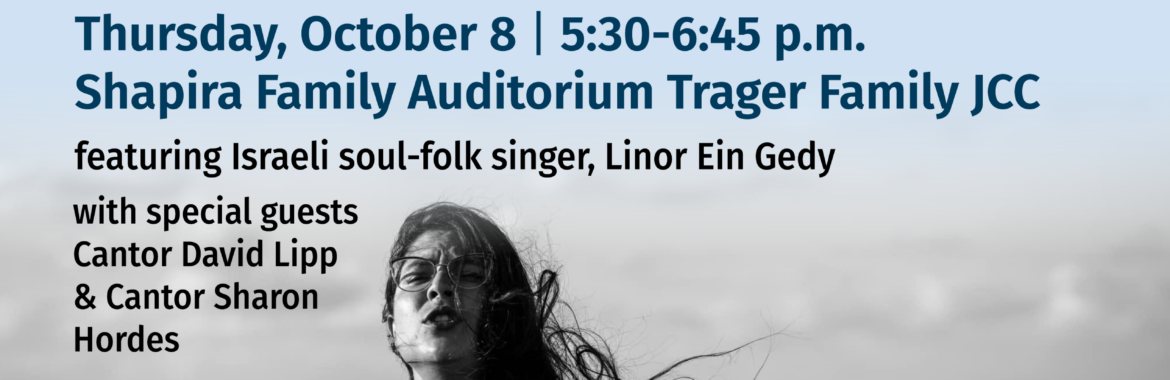
This year’s remembrance will take place Thursday, October 8 from 5:30-6:45 p.m. at the Trager Family JCC’s Shapira Family Auditorium. Titled “Songs for Hope and Peace,” the event will feature the return of Israeli soul-folk singer Linor Ein Gedy, along with contributions from Cantor David Lipp of Congregation Adath Jeshurun and Cantor Sharon Hordes of Keneseth Israel Congregation. The program will offer not only remembrance, but an opportunity to draw strength and comfort from one another, and to find hope and even a measure of inspiration from the
heartfelt resonance song.
Our ShinShinim Tamari and Yarden will also participate, and there will be a nearby companion exhibit of art works related to the Nova Festival.
During his Rosh Hashanah service this past September 11, Rabbi David Ariel-Joel — himself an Israeli native — acknowledged sentiments that might well apply to the emotional aftermath of October. 7.
“There’s a Jewish tradition as the year ends, and as we’re looking at the year to come, to say: May the year and its curses end; may the year and its blessings begin.
A few minutes later, speaking directly to congregants seated in rows before him, Rabbi Ariel-Joel invoked the oft-cited contrasting debates 2,000 years ago between followers of Rabbi Shammai and those of Rabbi Hillel – “a controversy among the people of Israel that’s been going on for thousands of years,” Rabbi Ariel-Joel said.
“It is a controversy between optimistic Jews and pessimistic Jews,” he continued, recounting how “the House of Shammai students claimed that it’s better not to be born into this world. This world is too hard, too messy,” so “it’s better not to be alive.”
But “the students of Hillel said, ‘On the contrary – it’s better for a person to be born and to be alive.’ They both agreed that now that we are born and alive, we should be useful. We should do something to make humanity better and to make the world better.”
And in what could be deemed an allusion to October 7, Ariel-Joel shared a forthright declaration: “To be continue to go from strength to strength, and not to be afraid to say yes to optimism.”
Michal Kofman, an Israeli associate professor of sociology at the University of Louisville, emphasizes that fundamental shifts in thinking and behavior are necessary to achieve something akin to post-October 7 harmony.
“My take is that peace is possible, but it requires hard, rigorous work, not empty slogans or wishful thinking,” she said.
“Wishing for peace achieves nothing; actively building it does. True peace work requires a painful but necessary step: acknowledging the “other” and taking responsibility for what they have endured, including the harm caused by our own side. Refusing to do this undermines any prospect of a lasting resolution, because a peace imposed on only one side’s terms is not reconciliation; it is an enforced surrender that only breeds future resentment.”
There is an existing Comprehensive Plan to End the Gaza Conflict, negotiated between Israel and Hamas, that has officially (if tenuously) been in effect since October 10 of last year. Whether it succeeds or fails remains an open question.
“I want to argue that any regional peace agreement must begin with the understanding that there must be no fences between Israel and its neighbors,” blogger Elkan Bar Eitan, who grew up in the West Bank settlement of Gush Etzion, wrote in a Times of Israel post on October 9, 2025 – the day the Gaza agreement was signed.
“The notion that peace requires ‘distance’ between peoples,” Eitan continued, “has produced a generation of Israelis and Palestinians who do not know one another – except through a lens of suspicion.”
Hope, Rabbi Ariel-Joel believes, is not the same as naivete. Nor is an optimistic mindset a simplistic glass-half-full mode of thinking.
During his Rosh Hashanah sermon, Ariel-Joel shared the example of Louis Brandeis, the storied Louisville native who in 1916 became the U.S. Supreme Court’s first Jewish Associate Justice.
“What is Jewish optimism in the United States of America?” Ariel-Joel asked rhetorically. “This is the optimism that brought a person from Louisville, Kentucky, Louis Brandeis, to be the first Jew on the Supreme Court of the United States – not to hesitate, not to be afraid to go through the most controversial and longest approval process in the history of the United States.”
We must be vigilant in the service of hope, Ariel-Joel urged, while acknowledging how Judaism’s ideals are not simply formalistic religious precepts.
“So many Jewish values are part of the narrative of America,” he said. “Jewish ideas like Tikkun Olam – repairing the world, caring for widows and orphans – are part of the pillars of Jewish communities all over the United States. As Jews, we have always fought to be in the forefront for civil liberties and human rights for everyone.”
Alluding to Louisville’s own example, “it is no wonder that in every Jewish community there’s a Jewish family and career services (agency) that works for the entire community, cares for the weak, for immigrants, and for the vulnerable in our society.
“This is an optimism that we really need right now,” Ariel-Joel stressed. “This is an optimism that in the last few years we started losing. We need to pull ourselves out of the defense mode we cornered ourselves into, and to go back to lead moral excellence in our society.
At the close of the upcoming remembrance ceremony, participants and guests will rise to sing the Israeli national anthem, Hatikvah – which means, “The Hope.”
Its text concludes with a yearning that applies not only on this occasion, but for all places and all time:
Our hope is not yet lost,
The hope of two thousand years,
To be a free nation in our own land,
The land of Zion and Jerusalem.
“‘Hatikvah’ says that Jews should never lose hope, should never lose optimism,” Ariel-Joel said. “Pessimism is a nowhere plan. ‘Hatikvah,’ Hope, is a choice, a knowledgeable choice – stubborn, determined, that can be fulfilled in harsh realities through small and big acts, and through an obligation to making the world better – to get up every day and to say in a loud voice that life has meaning, and we can always do better, even in the hardest times.”
Registration is necessary to attend the “Songs for Hope and Peace” remembrance Thursday, October 8 from 5:30-6:45 p.m. at the Trager Family JCC’s Shapira Family Auditorium. To register, go online at tinyurl.com/3z4uxkt3