



By Andrew Adler
Community Editor
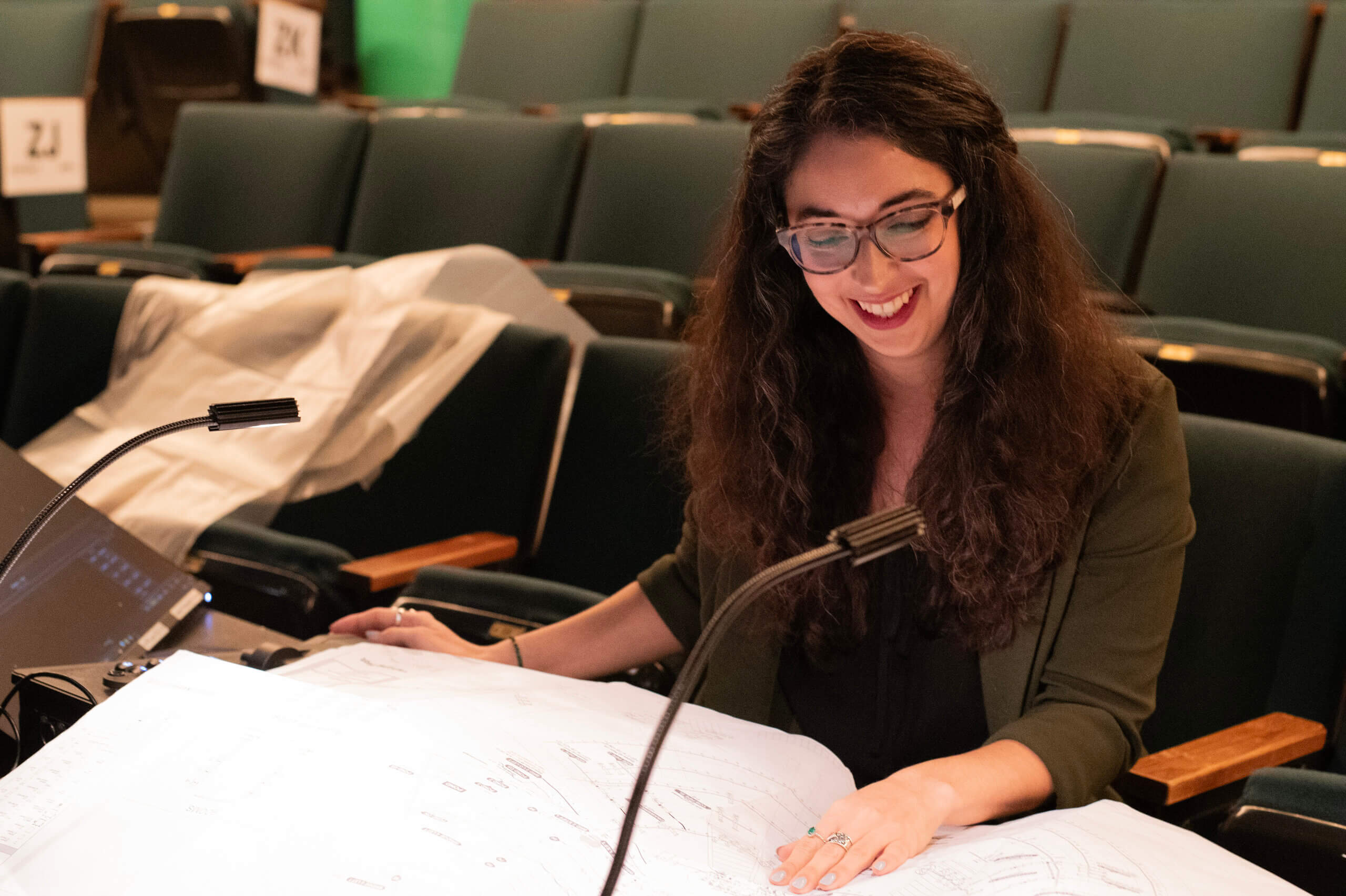
Amelia Acosta Powell knows quite a bit about life’s intriguing dualities.
Growing up in Denver as the daughter of a Roman Catholic mother and a Jewish father, she learned early on how to navigate the crosscurrents of sometimes contradictory personal dynamics. It’s a skill she honed professionally while ascending creative ranks at a series of regional theaters, culminating in her present gig: Artistic Director at Actors Theatre of Louisville.
As its creative leader, Acosta Powell is tasked with preserving ATL’s storied legacy while confronting the myriad challenges intrinsic to contemporary performing arts. Working alongside Managing Director Emily Tarquin, she represents a new generation of arts presenters. Just as Music Director Teddy Abrams has reinvigorated the Louisville Orchestra over the past decade, Acosta Powell, 36, must reimagine what ATL means not only for Louisville, but in a broader, nationwide context.
It’s a formidable imperative, especially considering the immense weight of ATL’s self-shaped traditions. Founded in 1964, the theater garnered international attention soon after Jon Jory came on as producing director five years later. Jory’s tenure included ATL’s most significant, ongoing component: the annual Humana Festival of New American Plays, which made its debut in 1976 and lasted until the Humana Foundation ended its underwriting in 2021.
Actors Theatre was the birthplace of Beth Henley’s Crimes of the Heart and Marsha Norman’s ‘night, Mother, two plays that became celebrated examples of touchstone American drama (and which won the Pulitzer Prize for Drama in 1981 and 1983, respectively).
Coincidentally, 2021 was also the year Acosta Powell came to Actors Theatre, hired as its first-ever “Impact Producer” collaborating with then-Executive Artistic Director Robert Barry Fleming. After he resigned in January of 2025, she and Tarquin were named to their posts on an interim basis before becoming
permanent the following Sepetmber.
Acosta Powell’s portfolio emphasized forging a “community connection piece, listening for what the needs and wants of the community are, finding ways to measure for those outcomes and focus our programming towards those outcomes,” she explained during a recent Zoom interview. “It’s a framing of what we, the regional theater companies, have always been doing,”
Before coming to Louisville, Acosta Powell did stints as Artistic Associate & Casting Director at Washington, D.C.’s Arena Stage, Line Producer at the Oregon Shakespeare Festival – and from 2019-2021, Associate Artistic Director at the Repertory Theatre of St. Louis.
She gained her earliest hands-on theatrical experience, literally, as a costume stitcher at D.C.’s Georgetown University, where she earned a bachelor’s degree in Theater and Spanish, plus a master’s in Spanish Linguistics.
Georgetown holds a foundational family connection: Acosta Powell’s mother and father met there while both were attending law school.
“I’m eternally grateful to them,” she said. “They raised my me and my sister with influence from our cultural background and a lot of openness to what we are drawn to.”
Acosta Powell’s Jewish father wasn’t especially observant in a formal, shul-specific sense, but Judaism nonetheless was a significant force in her young life.
“I would describe my upbringing as having Jewish culture in the foreground more than religion,” she recalled. “You know – celebrating holidays, and with all the Yiddishisms that are deep in our language.”
Acosta Powell appreciates the notion that, more often than not, being Jewish means seldom settling for a single point of view.
“One of my favorite things about Judaism — or at least the version of Judaism that I grew up with — is that it was all question and curiosity based, with little requirement of exactly how you practice the faith,” she said, “which I know is not true of every version of Judaism by any means. But that was the community I was a part of: very questioning.”
Though her father tends not to be formally observant, his mother – Acosta Powell’s late grandmother – whom she lived with while attending Georgetown — has been an anchoring presence in the realm of faith and practice.
“I find that my experience has been kind of matrilineal,” Acosta Powell said. “The time I lived in D.C, with my dad’s mother was quite formative, and I think she (was) the driver and holder of our family’s history and Jewishness.”
Indeed, “we do have a line of our family who came over to the United States after the pogroms in Russia. We also have a Holocaust survivor story in our family, so that’s of course a point of pride and importance.”
Her mother’s Mexican American heritage and her father’s Ashkenazi family origins have found a defining sensibility in Acosta Powell, who embraces her multifaceted origins with all appropriate fervor.
“Being a person of mixed heritage certainly has affected my life at every step,” she acknowledged. “But I don’t necessarily think that it’s core to my identity. I didn’t set out for it to be core to my work that I’m Jewish or Latina or queer or female — or any of the ways that I identify. Though of course I champion those identity groups and any other particularly underrepresented group because I have the lived experience of what that looks like.”
Still, Acosta Powell is wary of reducing layers of personality to a few easily digested tropes. “Humans are much more complex and interesting than labels,” she emphasized. “I feel pride in each of these communities, and I want to celebrate my participation and make other people who are part of those communities feel welcomed by me in turn.”
No wonder, then, that she’s committed to bolstering historically marginalized performance collectives – exemplified by her passionate advocacy on behalf of Hispanic theater.
“I have had the great privilege to be a steering committee member for Latinx Theater Commons, which is a national advocacy organization for Latina representation in theater,” she said, “and I’ve been a part of that for about 12 years. Opportunities beget opportunities, and I’ve met so many amazing people through that movement.”
Along similar lines, Acosta Powell has savored being able to “work with playwrights who then I got to direct the world premieres of their plays, and that has become a big part of what I do, and really do love. And in fact, it was I was so tickled when I finally got to pitch directing Hershel and the Hanukkah Goblins at Actors Theatre (in 2024) because I felt like, ‘Finally, I get to focus on a Jewish story.’”
Storytelling is intrinsic to Actors Theatre’s mission, and indeed ATL’s embrace of new, locally-sourced works centers on its Storytelling Revolution Festival – produced in tandem with Louisvillle Fringe — which made its debut this past April.
Elsewhere Acosta Powell herself has directed several productions and shepherded any number of others. She is as much a pragmatist as she is as artist, wanting to provide audiences with pathways to unexpected works while acknowledging the fiscal necessity of filling seats in ATL’s three performance spaces: the 633-seat Pamela Brown Auditorium, 300-seat in-the-round Bingham Theatre, and the intimate upstairs 124-seat black-box Victor Jory Theatre – named ATL’s founder (and Jon Jory’s father).
Post-pandemic realities, coupled with shifting audience patterns of attendance, mean that the present-day Actors Theatre is far more modest than in its heyday a generation ago. The full-time staff, which at its peak numbered more than 100, now stands at 24. The vaunted resident acting company, which once boasted such boldface names as Susan Kingsley, Kathy Bates, Ken Jenkins, Adale O’Brien and William McNulty, ceased to be decades ago.
And just as the Louisville Orchestra has witnessed its longstanding subscription framework give way to flex packages and single-ticket sales, so too has ATL’s reliance on subscribers willing to pay up front for an entire season’s offerings.
Still, there is a genuine belief that its audiences and presenters can enjoy a symbiotic relationship – where each entity benefits the other. Reputation may not be everything, but it still stands for something.
“I think the way that you maintain the idea that, ‘Well, I’ll go see it because Actors Theatre is putting it on, even if I don’t know anything about it, or recognize the title,’ comes from a trust that takes real time to build,” Acosta Powell said. That means ATL can produce crowd-pleasers like A Christmas Carol or the recent production of Ken Ludwig’s Baskerville: A Sherlock Holmes Mystery and less familiar fare along the lines of Eboni Booth’s Primary Trust, which won the 2024 Pulitzer Prize for Drama. Actors Theatre will stage it in the Bingham Theatre this coming Feb. 17-28
Acosta Powell directed Baskerville, touted in alliterative splendor as “dashing detectives juggle a dizzying web of clues, disguises and deceit.” A very different piece revealed itself amid the February 2024 original staging of Beto O’Byrne’s Loving and Loving, inspired by the U.S. Supreme Court’s landmark 1967 decision in the case of Loving v. Virginia that struck down laws banning interracial marriage.
The play’s thematic elements, steeped in the tension between prevailing norms and the freedom to express oneself without fear or apology, demonstrated how Actors Theatre could nurture a production that, in many respects, was decidedly unconventional. In that regard, the project dovetailed with Acosta Powell’s own inquiries about living authentically.
“I embrace a queer Jewish Latina identity, and I welcome other people with respect,” she said. “In some ways, this was my favorite thing about working on Loving and Loving. Fundamentally, “I think being mixed or multicultural is my strongest identity, because there’s always the feeling that you’re never quite enough of any one thing to feel like you belong.”